What does it take to cater an event for 1,000+ guests?
Successful large-scale catering requires scalable operational systems, strategic zone-based staffing, detailed site logistics planning, and built-in contingency protocols. Food quality alone is not enough, execution at high guest counts depends on documented processes, clear communication hierarchies, and a partner with proven experience at scale. RH Events & Catering has executed programs for up to 10,000+ guests and shared this framework at Catersource + The Special Event 2026.
What You Will Learn
- Why large-scale catering is a fundamentally different discipline than standard event catering
- The four operational pillars RH Events uses to manage 1,000+ guest programs
- How to approach staffing ratios, zone management, and contingency planning for high-volume events
- What site logistics look like in non-traditional or infrastructure-limited venues
- The 5-step planning process RH Events uses from discovery to teardown
- Answers to the most common questions about planning and executing large-scale catering
Large-scale catering, like a company picnic or an employee appreciation activity, is not simply a matter of cooking more food. When the guest count climbs past 1,000, 5,000, or 10,000, the operational demands shift entirely. Planning windows stretch, staffing structures grow more complex, logistics become as critical as the menu itself, and the margin for error shrinks to near zero. Getting it right requires a fundamentally different discipline than catering a 100-person dinner.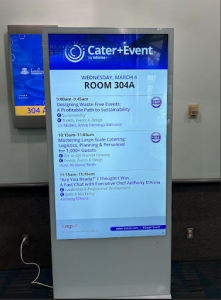
That discipline is exactly what RH Events & Catering brought to the stage at Catersource + The Special Event 2026 in Los Angeles, California. In a session titled “Mastering Large-Scale Catering: Logistics, Planning & Personnel for 1,000+ Guests,” the RH Events leadership team shared the systems, staffing structures, and planning frameworks they rely on to execute high-volume catering programs across the country.
Here is a deeper look at what was covered, why it matters, and how these principles apply to corporate event catering at scale.
Why Does Large-Scale Catering Require a Different Approach?
Most catering operations are built around efficiency at moderate volumes. You know your venue, your kitchen layout, your service staff, and your typical guest behavior. At 100 or 200 guests, experienced teams can adapt on the fly and fill gaps in real time.
At 1,000 guests and certainly at 5,000 or 10,000, that flexibility disappears. Every variable that seemed manageable at a smaller scale becomes a potential point of failure. Food holding times must be calculated to the minute. Service flow must be mapped against physical space in ways that prevent bottlenecks. Staff must know exactly where to be and what to do without waiting for direction.
RH Events & Catering, based in Powder Springs, Georgia, has spent more than 15 years supporting corporate programs at exactly this scale. Founded by Lee Reith and Steve Hunt, the company has built a reputation for reliable, precision-executed catering and event services for organizations nationwide, including marquee clients like WellStar, Duracell, Pilgrim’s, and GEICO. The Catersource session was a direct reflection of that accumulated operational experience.
What Did RH Events Present at Catersource + The Special Event 2026?
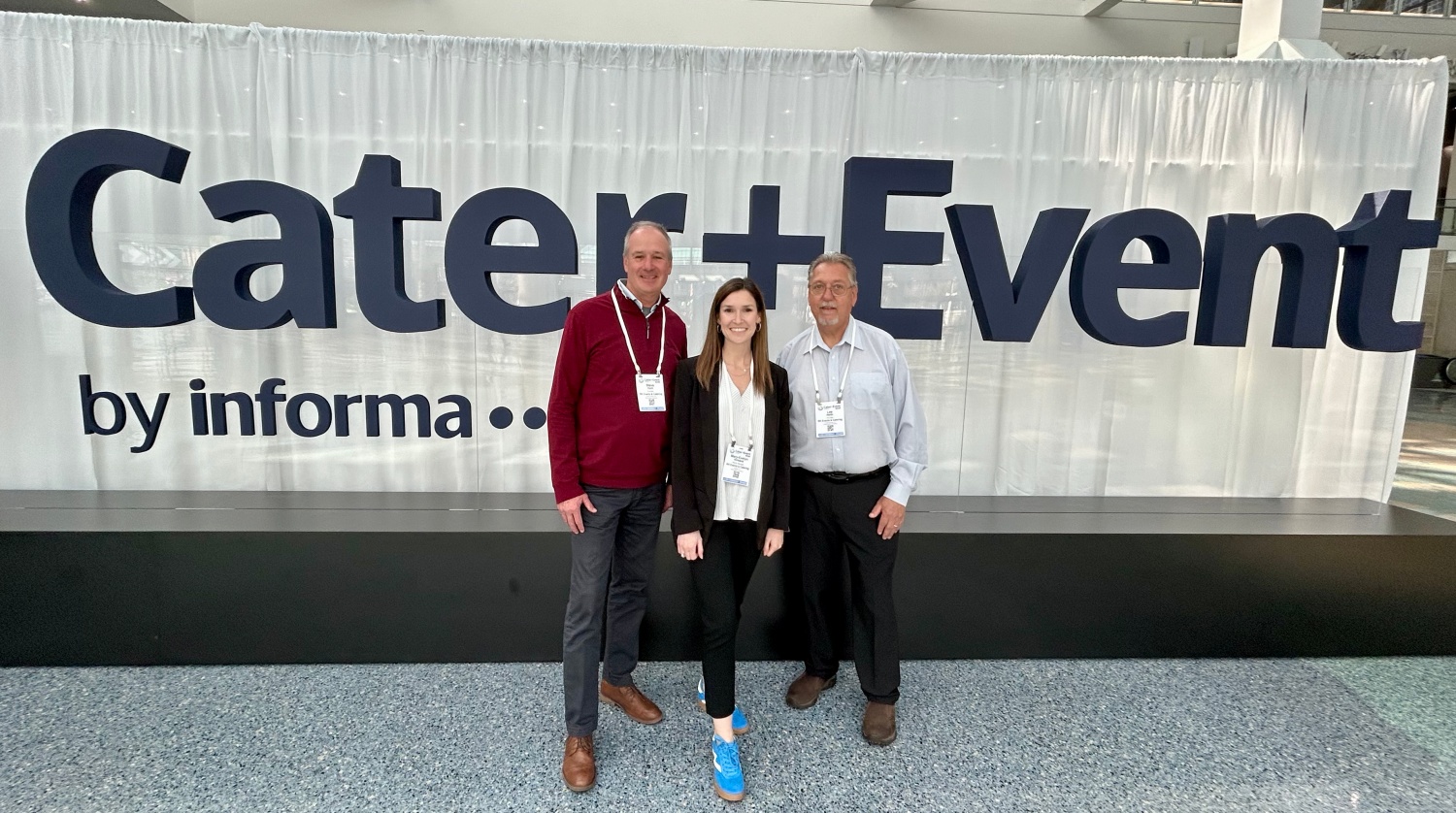
The session was presented by three members of the RH Events leadership team:
- Steve Hunt, Founder: 15+ years leading large-scale corporate event operations
- Lee Reith, Founder: nationwide corporate catering and logistics expertise
- Mary-Evelyn Kirkland, Media Manager: event communications and industry outreach
The session drew strong attendance and positive feedback from catering and event professionals seeking practical guidance for managing high-volume service. Rather than offering a theoretical framework, the RH Events team shared the real-world planning structures and systems they use when the stakes are high and the guest count is in the thousands.
The core message was direct: large-scale catering success depends on systems that hold up under pressure.
“Large-scale catering is a different discipline; success depends on systems that hold up under pressure. We were proud to share the planning and staffing structures we rely on to deliver consistent service when the scope is complex, and the guest count is high.”
— Steve Hunt, Founder, RH Events & Catering
What Are the Key Operational Systems for Catering 1,000+ Guests?
The session organized large-scale catering execution around four interconnected pillars. Each one addresses a specific failure point that becomes critical at high guest counts.
1. Scalable Operational Systems
One of the session’s central themes was the difference between a good catering team and a scalable catering system. Individual talent and experience matter, but at large scale, success cannot depend on any one person making the right call in the moment. It depends on documented processes, clear communication channels, and operational redundancy.
RH Events walked attendees through how they build operational systems around the specific variables of each event, including guest count, venue layout, menu complexity, service style, and timeline, so that every team member at every station knows exactly what is expected before the first guest arrives.
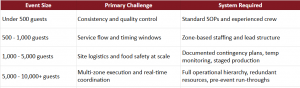
2. How Should You Staff a Large-Scale Catering Event?
Staffing for a 1,000-guest event is not simply a matter of multiplying your standard crew. Staffing structures need to be designed around service flow, venue zones, timing windows, and communication hierarchies.
Key considerations the RH Events team shared included:
- Staffing ratios tied to service style (buffet, plated, stations) and venue layout
- Zone management to prevent service gaps in remote or spread-out event footprints
- Lead structure so frontline staff always have a clear point of contact during service
- Pre-event briefings that align the entire team before doors open
- Contingency staffing to absorb no-shows or unexpected demand spikes without disrupting service
“Our team has supported corporate programs nationwide, and the details matter, from staging and staffing to food safety and flow. This session was designed to give event professionals practical ways to think about execution at scale, and we were encouraged by the response from attendees.”
— Lee Reith, Founder, RH Events & Catering
3. What Are the Biggest Site Logistics Challenges for Large Events?
Large-scale catering, like company picnics, often takes place in non-traditional environments; corporate campuses, outdoor venues, parks, fairgrounds, and industrial spaces where kitchen infrastructure is limited or nonexistent. With thousands of guests, getting food from production to service to guests safely and on time can be as challenging as the cooking itself.
Topics covered in the session included:
- Site surveys and advance planning to understand load-in routes, power availability, water access, and service zones before event day
- Temporary kitchen and staging setups for venues without permanent infrastructure
- Food safety protocols scaled to high-volume production, including temperature monitoring, holding equipment, and handoff procedures
- Traffic and flow mapping to prevent service line congestion and ensure consistent guest experience across the entire footprint
4. How Do You Execute a Large-Scale Catering Event Under Pressure?
No plan survives contact with reality perfectly intact. Weather changes, deliveries run late, headcount shifts, equipment fails. The session covered how RH Events builds contingency thinking into every plan so the team can adapt without losing momentum.
This includes decision trees for common failure scenarios, pre-designated backup resources, and leadership protocols that keep the event moving smoothly even when mid-execution adjustments are needed.
What Does Large-Scale Catering Look Like in Practice?
The session was grounded in real-world experience. RH Events has executed events for up to 10,000+ guests across the country, demonstrating exactly the systems described at Catersource.
Representative programs from RH Events’ portfolio include:
- A 4,000-person annual company picnic in Lula, Georgia, full production including catering, entertainment, activities, setup, and teardown at a non-urban venue
- An 800-person corporate event in Raleigh, North Carolina, demonstrating geographic reach beyond Georgia across the Southeast
- A 6,500+ employee company picnic for a single corporate client, with guest satisfaction and logistics management that earned long-term repeat business
“Katie Cantis planned a company picnic for 6,500+ employees with RH. The result: flawless execution, satisfied employees, and a relieved planning team.”
These programs reflect the same principles presented at Catersource: scalable systems, disciplined staffing, logistics-first planning, and consistent execution under pressure.
What Is the RH Events Process for Large-Scale Catering?
RH Events uses a structured five-step process that ensures nothing falls through the cracks from initial concept to final cleanup.
- Discovery & Visioning: Understanding the client’s goals, audience size, budget, venue, and event vision
- Proposal & Options: Building a custom event proposal with pricing, service style options, and logistics overview
- Vendor & Logistics Planning: Coordinating all vendors, permits, staffing, equipment, and site logistics
- Production & Day-of Execution: Full event production management with real-time oversight and contingency response
- Tear-Down & Wrap-Up: Complete teardown, cleanup, and post-event follow-up
This model, where a single experienced partner manages every detail from vision to teardown, is precisely what makes large-scale execution manageable. Rather than asking an HR team or event organizer to coordinate a dozen vendors simultaneously, RH Events absorbs that complexity entirely.
Why Did the Catering Industry Respond So Positively?
The strong attendee response at Catersource reflects a real content gap in the industry. Large-scale catering education tends to focus on culinary trends or business development. Operational depth, staffing structures, logistics planning, and contingency frameworks, is far less common in conference programming, and it is exactly what working professionals need.
RH Events’ decision to share behind-the-scenes operational knowledge rather than marketing-oriented messaging resonated with a professional audience looking for practical takeaways they could apply immediately.
With more than 15 years of experience executing programs at scale, RH Events has accumulated practical knowledge that is genuinely valuable to the broader industry, not just to its own clients.
Frequently Asked Questions: Large-Scale Catering Logistics
How far in advance do you need to plan catering for 1,000+ guests?
Large-scale catering programs typically require a minimum of 3 to 6 months of advance planning. Events with 5,000 or more guests or those held at non-traditional venues requiring temporary kitchen infrastructure may require 6 to 12 months.
The earlier a caterer is engaged, the more options are available for staffing, permitting, and
What makes catering in non-traditional venues more difficult?
Non-traditional venues, parks, corporate campuses, fairgrounds, outdoor spaces, often lack permanent kitchen infrastructure, reliable power, running water, and defined service zones.
This requires temporary kitchen setups, generator planning, water supply solutions, and detailed advance site surveys to identify load-in routes, staging areas, and guest flow patterns before event day.
What should corporate event planners look for in a large-scale caterer?
Look for a company with documented operational systems (not just talent), a track record at comparable guest counts, the ability to manage site logistics independently, strong food safety protocols, and a full-service model that reduces the number of vendors the client must coordinate. References from events at or above your planned guest count are essential.
How does RH Events & Catering support corporate programs nationwide?
RH Events is headquartered in Powder Springs, Georgia, and supports corporate programs across the Southeast, Midwest, and beyond.
Our service model includes company picnics, corporate catering, entertainment and activities, logistics and permitting, and full staffing, setup, and teardown. Geographic coverage includes Atlanta, Dallas-Fort Worth, Charlotte, Nashville, Orlando, Louisville, and more. Contact us to get a free quote.
What does full-service corporate event catering include?
Full-service corporate event catering covers everything from initial planning and menu design through day-of execution and post-event cleanup.
For RH Events, this means catering, entertainment, activities, logistics coordination, permit management, staffing, setup, and teardown, all managed by one team under a structured five-step process.
Start Planning Your Large-Scale Event
RH Events & Catering continues to grow its portfolio of high-volume corporate programs across the country. For organizations managing employee events, company picnics, corporate celebrations, or multi-day programs at high guest counts, the systems and expertise shared at Catersource represent the standard of care that every large event deserves.
Contact RH Events & Catering to discuss your program:
Call us at 770-635-7449, and let us help you plan your next event. You may also visit our website https://yesrh.com and fill in the form found on the site.
About RH Events & Catering
RH Events & Catering is a corporate event planning and catering firm that has supported client programs nationwide for more than 15 years. Founded by Lee Reith and Steve Hunt, the company provides comprehensive planning, logistics, staffing, and catering for corporate programs of all sizes across the United States.
With experience managing events for up to 10,000+ guests and a trusted client roster that includes WellStar, Duracell, Pilgrim’s, and GEICO, RH Events delivers reliable, high-impact events executed with precision.
